


A molecule that never reaches the bloodstream has little therapeutic value, regardless of what its label promises.
This challenge lies at the heart of the global nutraceutical industry, a market valued at over $450 billion and projected to grow at more than 7% annually. Pharmaceutical, consumer health, and life sciences companies continue investing heavily in nutraceutical portfolios. Yet one longstanding obstacle continues to limit clinical credibility, weaken product differentiation, and reduce long-term commercial value: poor bioavailability.
The issue is not a lack of awareness but a lack of strategic action.
The Bioavailability Challenge
Bioavailability, the proportion of an active ingredient that reaches systemic circulation in a biologically active form, determines whether promising laboratory findings translate into meaningful clinical outcomes. It is influenced by molecular weight, lipophilicity, solubility, gastrointestinal pH, enzymatic degradation, and intestinal permeability. These pharmacokinetic factors ultimately determine whether a product delivers measurable benefits or merely market appeal.
Curcumin illustrates the problem clearly. Clinical studies report oral bioavailability ranging from 0.16% to 1%, even at doses up to 12 g/day. More than 90% of orally administered curcumin is eliminated before reaching systemic circulation, demonstrating that increasing the dose alone does not necessarily improve therapeutic exposure.
This challenge extends well beyond curcumin. Polyphenols, carotenoids, omega-3 fatty acids, and many bioactive peptides face similar barriers, including poor solubility, limited intestinal permeability, and extensive first-pass metabolism. For product developers, these limitations are not academic concerns, they directly influence efficacy, market differentiation, and commercial success.
Why Bioavailability Matters More Than Ever
The nutraceutical industry can no longer rely on assumptions about absorption.
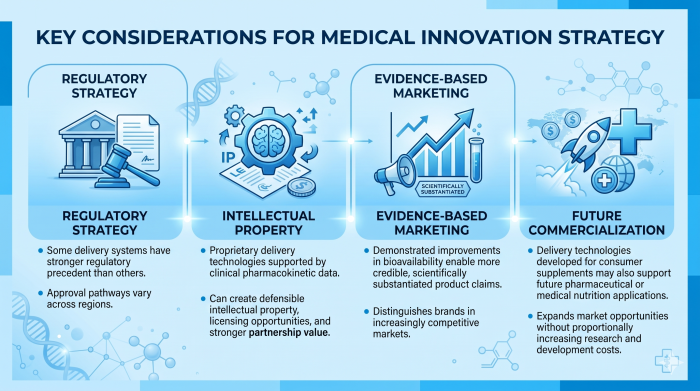
First, regulatory expectations are increasing. In the United States, the FDA’s DSHEA framework emphasizes safety, while expectations for evidence supporting efficacy continue to grow. In contrast, the European Union requires rigorous scientific substantiation before approving health claims. Companies pursuing global commercialization must therefore address increasingly diverse regulatory requirements, making bioavailability data an important competitive advantage.
Second, investors are demanding stronger evidence. As venture capital, private equity, and pharmaceutical companies expand their involvement in nutraceuticals, due diligence increasingly includes formulation science and pharmacokinetic validation. The rapidly growing bioavailability enhancement market reflects continuing demand for technologies that solve, rather than merely acknowledge, absorption limitations.
Third, healthcare systems are incorporating nutraceuticals into evidence-based practice. Sustained integration depends on robust clinical evidence, and clinical evidence depends on reliable delivery of active compounds.
Applying Pharmaceutical Science to Nutraceuticals
The encouraging news is that many solutions already exist.
Pharmaceutical research has spent decades addressing poor solubility, limited permeability, and metabolic instability. The Biopharmaceutics Classification System (BCS) provides a well-established framework for selecting appropriate delivery strategies based on solubility and permeability characteristics. Lipid-based formulations, nanocarriers, and transporter-mediated delivery systems have all demonstrated the ability to improve systemic exposure for challenging compounds.
What has been lacking is the consistent application of these pharmaceutical principles to nutraceutical development. Bridging this gap offers an opportunity to improve clinical performance while strengthening regulatory and commercial positioning.
Evidence supporting advanced delivery technologies continues to grow. For example, micellar curcumin formulations have demonstrated approximately a 57-fold increase in systemic exposure compared with conventional curcumin, while γ-cyclodextrin complexes have achieved roughly 30-fold improvements. These are not incremental gains; they fundamentally alter the pharmacokinetic profile and clinical potential of the product.
Emerging Delivery Technologies
Modern delivery platforms, including liposomes, nanostructured lipid carriers (NLCs), polymeric nanoparticles, nanoemulsions, dendrimers, and bilosomes, provide multiple strategies for improving bioavailability. Selection should extend beyond technical performance to include regulatory acceptance, manufacturing scalability, product stability, cost, and intellectual property potential.
Looking Ahead
Bioavailability should no longer be viewed as a formulation detail. It is a strategic determinant of clinical performance, regulatory success, and long-term commercial value.
As scientific standards continue to rise, organizations that invest in evidence-based delivery technologies will be better positioned to deliver products that not only reach consumers but also achieve meaningful biological impact.
About the Author
Jaclyn P. Leyson-Azuela, RMT, MD, MPH
Dr. Leyson-Azuela is a physician, public health professional, and medical writer specializing in healthcare innovation, pharmaceuticals, medical technology, health policy, and evidence-based medicine. With expertise spanning clinical practice, public health, and scientific communication, she translates complex healthcare developments into strategic insights for healthcare leaders, industry stakeholders, and decision-makers.
About Phaidros Healthcare
Phaidros Healthcare is a science-driven healthcare company committed to advancing evidence-based innovation across pharmaceuticals, nutraceuticals, and medical technologies. Guided by rigorous research and a commitment to clinical excellence, we collaborate with healthcare professionals, researchers, and industry partners to translate emerging scientific discoveries into practical solutions that improve patient outcomes. Our focus extends beyond product development to fostering informed discussions on formulation science, bioavailability, regulatory trends, and healthcare innovation. By bridging cutting-edge pharmaceutical expertise with evolving nutraceutical technologies, Phaidros Healthcare supports the development of high-quality, clinically credible solutions that meet the growing demands of modern healthcare. Through thought leadership, strategic partnerships, and a steadfast commitment to scientific integrity, we strive to empower clinicians, industry stakeholders, and consumers with knowledge and innovations that drive better health and lasting value.
